
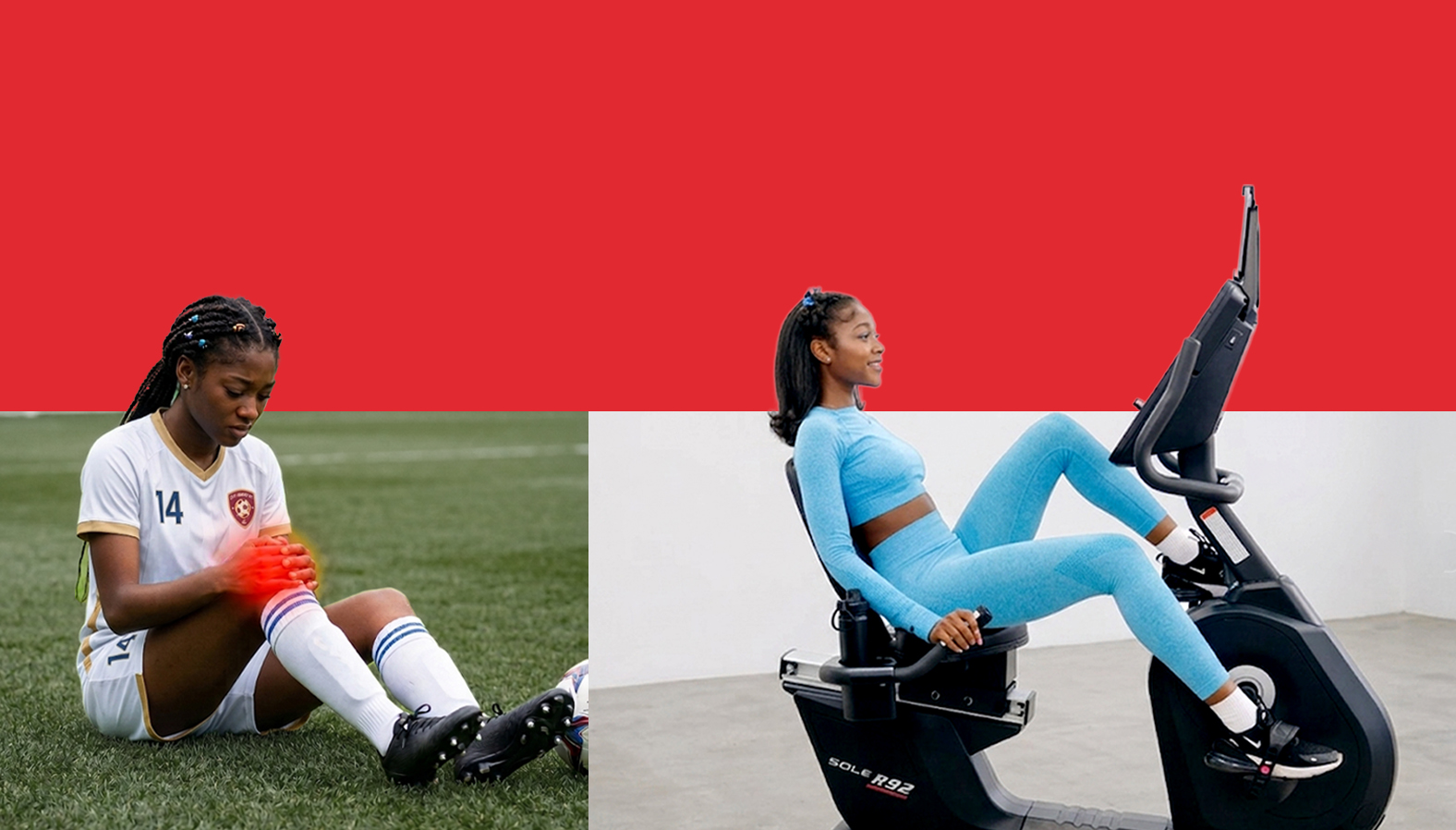
Disclaimer: Always consult your orthopedic surgeon or physical therapist before starting a cycling routine to ensure it is appropriate for the specific stage of your recovery.
Key Takeaways
- Knee injury recovery, with or without surgical intervention, requires a bike that controls knee flexion, eliminates leg-over mounting, and allows progressive loading from zero resistance upward as the injury heals.
- A standard upright or spin bike can stress the injury through rotational pedal forces, aggressive seat geometry, and balance demands that the early-recovery knee may not be ready to absorb.
- Physical therapists widely recommend recumbent exercise bikes for knee injury recovery because they provide low-impact, guided motion that helps stabilize the knee without the weight-bearing strain of walking.
- SOLE Fitness offers three recumbent exercise bikes featuring contoured lumbar support, step-through access, and 2-degree inward pedals that hold the knee in natural alignment throughout every stroke.
- All three SOLE recumbent bikes feature magnetic resistance designed to support the precise progression that knee injury rehabilitation and recovery require.
Knee Injuries in Canada: By the Numbers
The knee is a complex joint with many components, making it vulnerable to a variety of injuries. While many knee injuries can be treated with simple measures, other, more severe injuries may require active rehabilitation or surgery.
The type of treatment your doctor recommends will depend on several factors, including the severity of your injury, your age, your general health, and your activity level.
Research cited by the Canadian Community Health Survey estimates that 4.27 million Canadians aged 12 and older experienced injuries that interfered with their daily activities during a one-year period.
Statistics Canada also found that activity-limiting knee injuries ranked third, behind ankle and foot injuries and wrist and hand injuries.
The most common knee injuries include:
- Soft-tissue tears, including ligament and meniscus tears
- Fractures
- Dislocations
- Injuries involving multiple structures within the knee
The anterior cruciate ligament, or ACL, accounts for a significant share of severe knee ligament injuries and is commonly associated with joint instability requiring surgical treatment.
Stationary cycling, particularly on a recumbent exercise bike, has become a common part of post-operative rehabilitation because it helps restore range of motion without the ground impact associated with walking or running.
The guide below explains which exercise bike features matter most during knee rehabilitation and recovery.
What Bike Features Matter Most for Knee Injury Recovery?
Seat Positioning and Adjustability
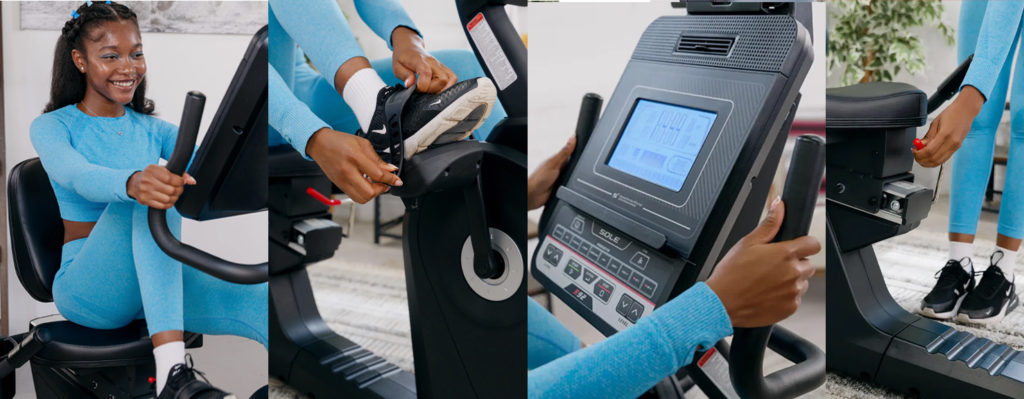
Proper seat distance controls the knee flexion angle at the bottom of the pedal stroke, directly affecting the amount of stress placed on the joint.
Positioning the seat too close can place the knee in excessive flexion, potentially beyond 90 degrees, and may add unnecessary stress to the recovering joint. Positioning the seat too far away can cause the knee to overextend, which may also create problems.
Important seat-adjustment features include:
- Multiple seat positions for precise adjustment
- An easy-to-use adjustment mechanism that does not require tools
- Clear position markers for maintaining consistent settings
- A sufficient adjustment range for users with initially limited mobility
- A stable seat that remains secure during exercise
As knee mobility improves, the seat can gradually be adjusted according to the recommendations of your physical therapist or healthcare provider.
Step-Through Frame Design
Traditional exercise bike frames may require users to lift one leg over a crossbar to reach the seat. During knee injury recovery, this movement can place unnecessary strain on the healing knee.
It may also increase the risk of losing balance, particularly during the early stages of recovery when strength and stability are limited.
Look for a bike with:
- No crossbar or a very low crossbar
- A clear, unobstructed path to the seat
- A stable frame that does not move during mounting
- A low and accessible seat height
- Secure handles for additional support
All three recommended SOLE recumbent exercise bikes feature step-through frames designed to make mounting and dismounting easier throughout recovery.
Resistance System
Knee injury recovery requires progressive loading. Most users begin with little or no resistance and gradually increase the workload as mobility, strength, and tissue tolerance improve.
The resistance system should support this gradual progression without sudden jumps in difficulty.
Look for:
- A very low starting resistance
- Multiple incremental resistance levels
- Smooth transitions between resistance settings
- Electronic resistance adjustment
- Quiet magnetic resistance
- Consistent pedal movement throughout each rotation
A bike with 20 or more resistance levels generally offers enough flexibility for gradual rehabilitation progression.
Pedal Design
Secure foot positioning helps prevent slipping and sudden leg movements that could place additional stress on the knee.
The foot should remain stable throughout the entire pedal stroke.
Helpful pedal features include:
- Adjustable foot straps
- A wide pedal platform
- A non-slip surface
- Easy foot entry and removal
- Stable positioning without excessive tightness
All SOLE recumbent bikes feature oversized pedals with adjustable foot straps, creating a stable platform for rehabilitation exercise.
The 2-degree inward pedal angle may be particularly helpful during ACL and knee injury recovery.
Many people’s legs naturally angle slightly inward from the hip toward the ankle. Pedals that point completely straight forward may require the knee to compensate during each stroke.
A subtle inward pedal angle helps maintain more natural lower-body alignment and may reduce unnecessary rotational stress through the knee.
All SOLE recumbent exercise bikes feature this 2-degree inward pedal design.
Stability and Weight Capacity
People recovering from knee injuries may experience temporary balance issues, muscle weakness, and reduced confidence when sitting down or standing up.
The exercise bike should remain stable during both mounting and use.
Look for:
- A heavy and stable base
- A wide frame stance
- Non-slip floor contact points
- Leveling feet
- An appropriate maximum user weight
- Secure support handles
Always choose a bike with a weight capacity that comfortably accommodates the intended user.
The SOLE Fitness Line of Recumbent Bikes
For the earliest medically cleared cycling phase, recumbent positioning is often preferred because the supported seat distributes body weight, reduces balance demands, and allows users to control their range of motion more precisely.
SOLE offers three recumbent exercise bikes that can support different rehabilitation needs, budgets, and workout preferences.
1. SOLE LCR: A Feature-Rich Recumbent Bike Offering Form and Function
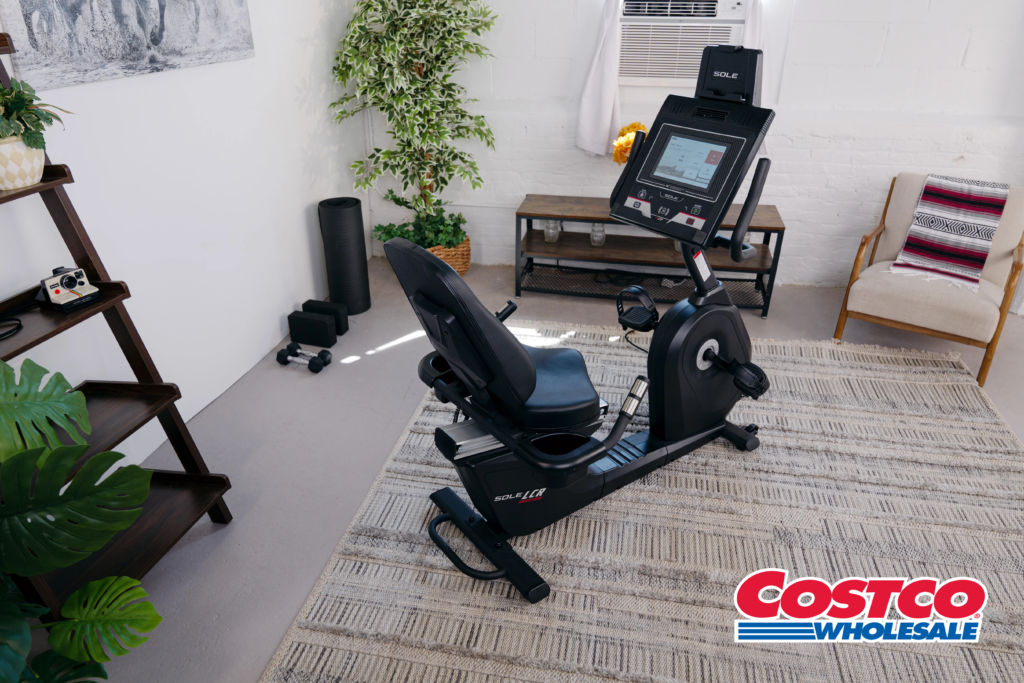
A Costco Canada exclusive, the SOLE LCR provides a supportive platform for knee injury rehabilitation with recumbent positioning, contoured lumbar support, a step-through frame, and 2-degree inward-facing pedals.
These features help maintain comfortable body positioning and natural knee alignment throughout the pedal stroke.
The full back support reduces the amount of balance required while cycling, while the step-through frame provides an unobstructed path to the seat.
40 Levels of Magnetic Resistance
The SOLE LCR includes 40 magnetic resistance levels, providing the small resistance increments that progressive rehabilitation may require.
Users can begin with zero or minimal resistance during early range-of-motion work and gradually increase resistance as directed by a physical therapist.
Compared with bikes that offer fewer resistance levels, the LCR allows users to make smaller changes between workouts. This can help prevent rehabilitation progression from exceeding what the healing knee is ready to tolerate.
Contoured Back Support
The contoured lumbar backrest supports a comfortable seated position during both short range-of-motion sessions and longer workouts later in recovery.
The seat design helps distribute body weight and reduces the need to stabilize the upper body while pedalling.
Touchscreen and SOLE+ App
The 10.1-inch touchscreen provides access to the free SOLE+ App.
Users can monitor workout information such as:
- Exercise duration
- Resistance level
- Cycling progress
- Workout history
- Performance patterns over time
This information may help users and their physical therapists monitor rehabilitation progression more objectively.
2. SOLE R92: Best Feature-to-Cost Value for Recovery
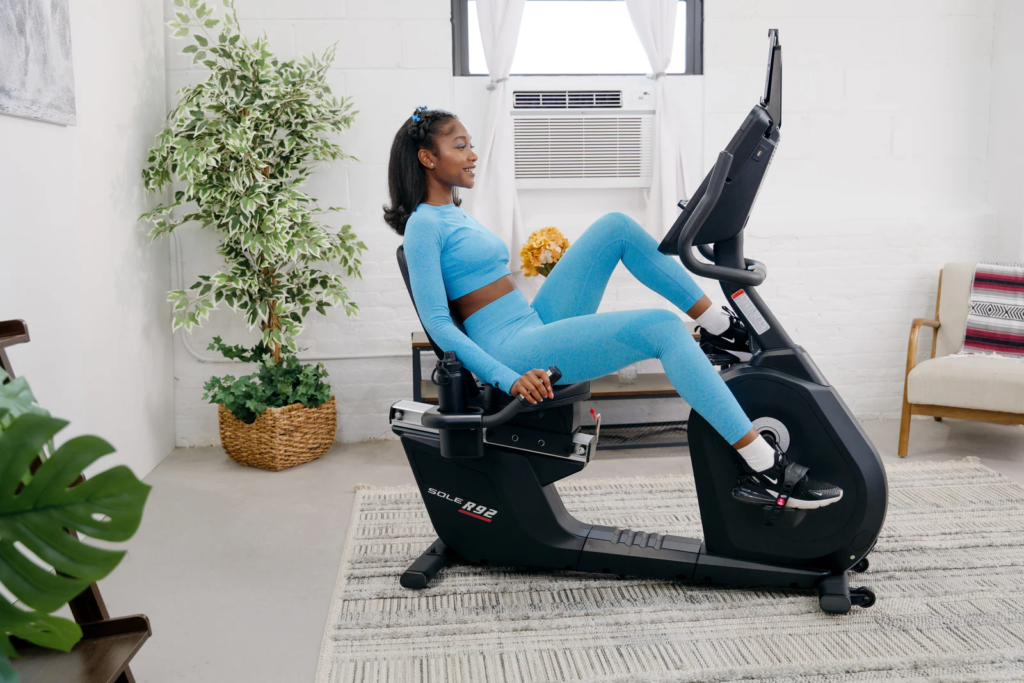
The SOLE R92 offers many of the core rehabilitation benefits of recumbent cycling at a more accessible price point.
It provides the supported seating position that knee injury recovery may require, along with quality construction and straightforward controls.
The step-through frame, contoured backrest, and magnetic resistance system provide the essential features needed for comfortable, low-impact cycling.
For users who do not require the LCR’s touchscreen or higher maximum user weight, the R92 offers a practical balance between features, comfort, and price.
20 Levels of Magnetic Resistance
The SOLE R92 includes 20 levels of ECB magnetic resistance, allowing users to progress from very light cycling to a more moderate workout.
Although it offers fewer resistance levels than the LCR, its 20 levels still provide sufficient adjustment for many rehabilitation programs.
Users can begin at a minimal resistance and gradually increase the difficulty as strength and comfort improve.
Workout Tracking
The 9-inch LCD console displays important workout information.
When paired with the SOLE+ App, users can also monitor workout history and track their progression over time.
Comfortable Seating
The contoured backrest supports comfortable positioning during increasingly longer sessions.
Its wide, padded seat helps distribute body weight evenly and reduce pressure points during exercise.
The R92 has a 300-pound maximum user weight capacity. Users who are close to or above this limit may prefer the LCR, which offers a 350-pound capacity.
3. SOLE R52: Best Recumbent Bike for Knee Injury Rehab on a Budget
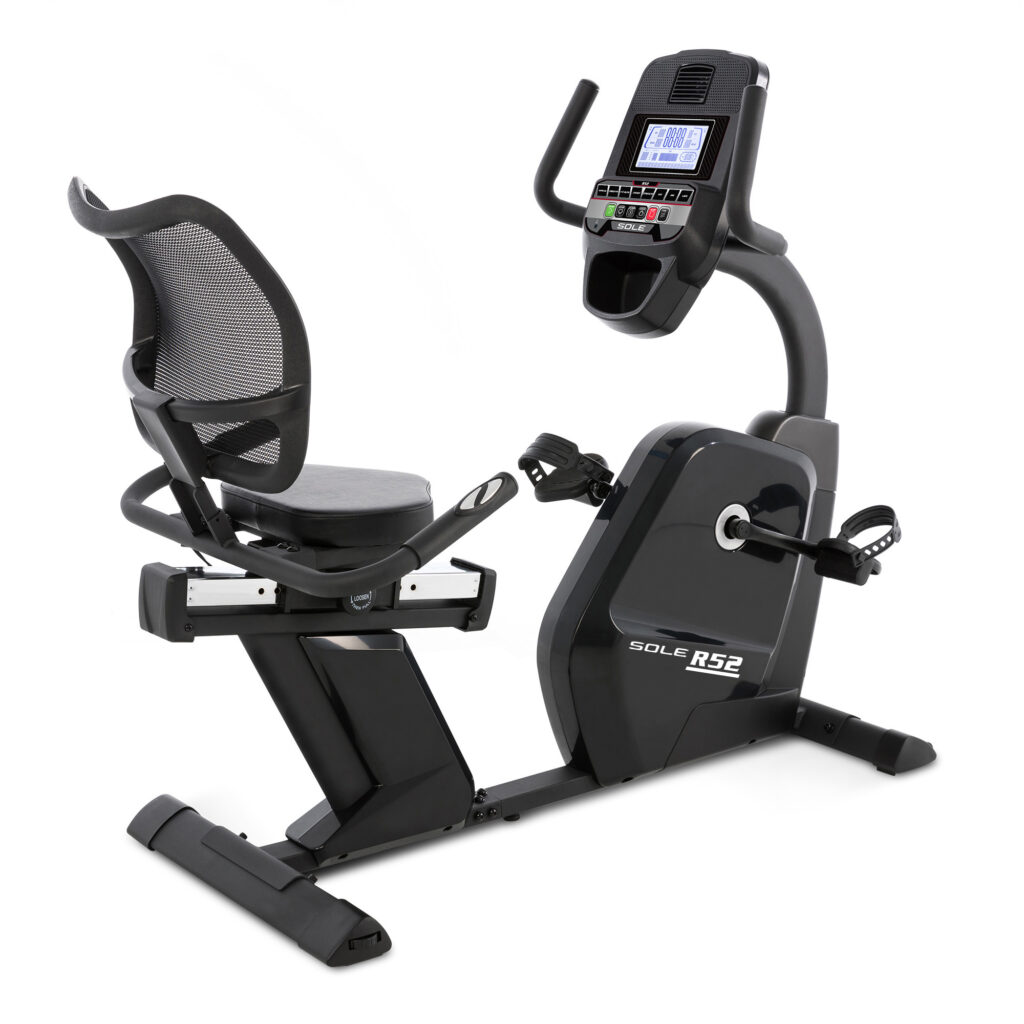
The SOLE R52 is a practical entry-level option for users who want the benefits of recumbent cycling without purchasing a premium model.
It provides the core features that matter during knee rehabilitation:
- Supported recumbent seating
- A true step-through frame
- An adjustable seat
- Oversized pedals
- Adjustable foot straps
- Computerized magnetic resistance
Comfortable and Accessible Design
The breathable mesh backrest and large cushioned seat support comfortable, low-impact cycling.
This design may help reduce pressure and discomfort during longer exercise sessions as recovery progresses.
The 12-position forward and backward seat adjustment allows users to find an appropriate pedalling distance and modify the position as knee mobility improves.
24 Levels of Resistance
The R52 includes 24 levels of computerized magnetic resistance.
This provides sufficient progression for early and moderate rehabilitation exercise.
Users can begin with a very light resistance for range-of-motion cycling and gradually increase intensity as strength, mobility, and confidence improve under the guidance of a physical therapist.
Straightforward Workout Feedback
The 6.5-inch white backlit LCD console displays essential workout information, including:
- Time
- Distance
- Speed
- RPM
- Heart rate
- Resistance level
- Calories
For users seeking a straightforward and budget-friendly recumbent bike focused on comfort, stability, and gradual progression, the R52 is a practical choice for at-home knee injury rehabilitation.
Which SOLE Recumbent Bike Is Best for Knee Injury Recovery?
The best model will depend on your budget, body weight, preferred display, and desired level of resistance control.
Choose the SOLE LCR if you want:
- The smallest resistance increments
- 40 magnetic resistance levels
- A large touchscreen
- A higher maximum user weight
- Advanced workout tracking
Choose the SOLE R92 if you want:
- A balance between price and features
- A comfortable padded seat and backrest
- 20 magnetic resistance levels
- SOLE+ App compatibility
- A straightforward LCD console
Choose the SOLE R52 if you want:
- A more budget-friendly option
- A breathable mesh backrest
- 24 computerized resistance levels
- Essential workout feedback
- A simple bike for gradual home rehabilitation
Regardless of the model selected, always follow the progression recommended by your orthopedic surgeon or physical therapist.
Shop the SOLE Bike Collection
Explore the full SOLE bike collection to compare specifications, resistance levels, seat designs, consoles, and maximum user weight capacities.
Frequently Asked Questions
When Can I Start Using an Exercise Bike After Knee Surgery?
The appropriate timing depends on the surgical technique, the type of injury or graft, your range of motion, and your individual healing progress.
Some patients may receive clearance for stationary cycling approximately two to four weeks after surgery, while other rehabilitation protocols may begin earlier or later.
Always wait for specific clearance from your orthopedic surgeon or physical therapist before beginning.
Should I Buy a Recumbent or Upright Bike for Knee Injury Recovery After Surgery?
A recumbent bike is commonly preferred during early recovery because it provides back support, requires less balance, and is easier to mount.
An upright exercise bike may be introduced later, once strength, stability, and mobility have improved.
Some users begin with a recumbent bike and transition to an upright bike during a later phase of rehabilitation. The most appropriate option will depend on your healthcare provider’s recommendations.
Can I Use a Regular Spin Bike for ACL or Knee Surgery Recovery?
Indoor cycles, commonly called spin bikes, are generally less suitable for the early stages of ACL or knee surgery recovery.
Their higher seat position, forward-leaning posture, leg-over mounting style, and more aggressive riding geometry may create challenges for someone with limited strength or mobility.
A recumbent bike or step-through upright bike is usually easier to access and control during early rehabilitation.
A spin bike may become appropriate during a much later stage of recovery, but only after receiving clearance from a physical therapist or healthcare provider.
Is a Recumbent Bike Good for Knee Pain?
A recumbent bike can provide low-impact movement while supporting the back and reducing balance demands.
However, knee pain can have many different causes. Before beginning an exercise routine, speak with a medical professional to determine whether cycling is appropriate for your condition.
How Much Resistance Should I Use During Knee Rehabilitation?
Begin only at the resistance level recommended by your physical therapist.
Early rehabilitation may focus on gentle range-of-motion cycling with very little resistance. Resistance can then be increased gradually as mobility, strength, and comfort improve.
Stop exercising and consult your healthcare provider if you experience sharp pain, increased swelling, instability, or symptoms that continue after the workout.